Leadership involves influence and relationship between the leader and the people who have chosen to be followers (Kouzes et al., 2017). Silva (2016) argues in support of leadership involving influence but one that is more relational and entails followers’ acceptance of their leader and their common focus towards the shared goals. This relational dimension and the choice by followers is hinged on the leader’s authenticity and credibility (Kouzes et al., 2017). To lead successful organizations especially in this season of the covid-19 pandemic, leaders will be required to have clarity of values that amalgamates with institutional values and followers values (Silva, 2016).
The mainstream media in Kenya, Africa, and the world is full of scandalous information that questions the credibility of leaders who were thought to be effective. This is observable across all organization sectors from the religious, public sector, political and even the private sector and includes such practices as corruption, manipulation of data and financial information, leadership wrangles, sexual harassment, among other such accusations of sexual misconduct which touches on prominent and perceived effective leaders. This has brought about severe gaps in leadership credibility.
Check out the detailed academic peer-reviewed publication by our CEO Gilbert A. Ang’ana on this topic through the below link.
We are less than a year to our election date and as usual, the quest for alliances, partnerships and collaborations have been on now for several months. We have seen the push for the Mountain unity which is not taking shape due to differing selfish ambitions of the Mount Kenya region’s leaders, we are seeing the North Eastern block coming up with their alliance as a region, the leaders from the Coast for some time now have been pushing for their regional alliances, and we have seen the Eastern block in discussions to form their alliance too.
For several years the Western region has been on the push to have a western united front but have not fully succeeded, the Nyanza region through the years have had fanaticism of the Prime minister. However, that too is starting to show cracks as some leaders within the region over the last few years have started standing their ground on extreme issues against the fanaticism of the prime minister. There has also been a push for the Upper Nyanza region of Kisii County and surrounding to form their alliance pulling in one of the influential cabinet secretaries as their lead.
The question that many Kenyans would then ask is how many such alliances we would have for the 47/48 tribes in Kenya now?
What is the sustainability of such regional or tribal alliances?
What message are we passing to our children who are born in cross-tribal marriages and do not fit in such one tribal and regional alliances?
In addition, away from regional blocks majorly pegged on selfish, tribal lines and ambitions, there has been a quest for national unity based on various idealisms. United Democratic Party (UDA) with their idealism of bottom-up economy have been making strides in pulling in the youth, entrepreneurs and what they term the citizens at the bottom to try and lure them for support ahead of the coming elections.
The One Kenya Alliance (OKA) have also been busy individually driving their agenda as they still work on a common alliance. ODM has also been popularizing their party with push and scramble for Mount Kenya support working to lure majorly with the region political and business leaders at this point. As recent as yesterday 28th September 2021, we saw the advancement taking shape with the meeting of key business and opinion leaders in the mountains. Other perceived political parties seem to be dying silently including the party that is supposed to be the current ruling political party.
Not to mention that there have been a few individuals who have also expressed their presidential bid for 2022 including Reuben Kigame a celebrated musician in Kenya but are yet to fully take off in their presidential campaigns.
The key question in many Kenyans minds is, are the agenda being driven by these arguably national alliances pertinent to the needs of the country? Are the leaders authentic in their push or is it a political carrot and stick game?
Do we even have national agendas highlighted in some of the alliances or is it selfish ambitions being driven? Are the alliances genuine or will they be the same old as we have seen last 3 decades?
Are all these TRIBAL alliances or SELFISH quest for collaboration or REAL transformative collaboration?
Are we ready as Kenyans and more so the Youth in Kenya to accept and also be part of the TRIBAL and SELFISH quest alliances?
I recently wrote an article on Collaborative leadership that aimed to share my expert opinion that I strongly feel is also critical in politics.
Two key aspects, in my opinion, I consider critical as we review and align with the various coalitions and alliances is to check below areas:
NATIONAL AGENDA/VISION
REAL and GENUINE Collaboration must have a shared NATIONAL unity vision and goal.
Any of the above alliances that do not drive NATIONAL focus is more of tribal or regional alliance with selfish ambitions that are likely not to be fulfilled when such leaders ascend to power. Such alliances for sure does not represent the spirit of unity in leadership embed in our constitution. However, this might also be argued that it embeds the spirit of unity of the region and for sure that is true and thus my argument that such alliances are tribal/regional and based on selfish agenda.
AUTHENTIC LEADERS
REAL and GENUINE Collaborative Leadership is AUTHENTIC
We know our various leaders who are driving these alliances and collaborations. The key question to ask is do we have authentic leaders in them? Some pointers of what authenticity is not would help us understand and gauge if the leaders leading these alliances are authentic leaders or not. Authenticity is not sincerity but, self-referential; Authenticity is not impression management like we have seen the leaders doing but, is to serve selfishness; Authenticity is not self-monitoring but, a commitment to integrity and values. This means that Authentic leaders have a high level of ethics, integrity and quest to serve not to be served. Are these the leaders leading these alliances and collaboration? I live you to review.
In the words of one of our top leaders “The fact of the matter is that we are a tribal society, and this is what divides us,” he said. “We pretend that we are national leaders. But when the time comes, we switch to tribal vernacular and become what we are.”
It is up to you and me to make that call of where our focus will become 2022 elections, which camp to support now as we move to 2022, which leaders to follow and eventually vote them in, and which to unfollow and vote them out, which leaders have the NATIONAL agenda at heart, which leaders are perceived to drive their SELFISH agenda?
Are the formations we are currently seeing TRIBAL or GENUINE quest for collaboration with the NATIONAL agenda at HEART?
Do we have AUTHENTIC & COLLABORATIVE LEADERS?
You Decide!
About the Author:
Gilbert Ang’ana is the CEO of Accent Leadership Group. He is an expert source for topics relating to all matters leadership, coaching, and organization development and a regular content contributor to various online publications. Gilbert is also a Director at Innovate Leader Academy an online academy that teaches matters leadership. He is a Leadership Coach, Scholar, and an Independent Research Fellow.
Collaboration In simpler terms means the way people engage or partner or come together and pull in their expertise for the benefit of a shared goal, vision, or mission. Collaboration involves tam work or partnership and the success of the team or the partnership in terms of achievement of the shared vision, mission or task depends on the nature of relationships within the team or partnership.
So, Why is Collaboration important in today’s interconnected world?
There are many reasons to give on why organizations, individuals today must collaborate; the main reason being no organization, individual, and nation can survive on its own regardless of the number of resources they have or own. Some of the other reasons that are worth noting is that: collaborations help organizations and individuals to solve complex problems easily; collaboration informs the way individuals, countries, organizations, and team works; the more the people engaging and supporting one another towards a task or project the easier it becomes to spot problems and solve them. We have seen the epitome of collaborations in the current period of the pandemic, where all countries, organizations, and individuals have been pulling together to get a vaccine that would help ease the scale of deaths and infections we have experienced over the last 1 year and the success of such collaborations have yielded into a vaccine today that has helped ease the pressure in many countries so far.
Collaboration also helps bring people together and fosters cross-learning from each other; in collaborations, countries, organizations, bring individuals with varied skills and diverse backgrounds together to work towards a specific shared vision or project. These people possibly could never have worked together in such a setting. For example, a financial institution trying to build their digital financial service (DFS) systems would need to have individuals from various departments internally to work towards their goal of delivering robust DFS system; Today’s many countries have pulled together towards the long term collaboration of finding a sustainable solution for the pandemic regardless of the current vaccine, there are still many collaborative studies going on to understand the nature of Covid-19 and how best to find a long term solution. Safaricom Plc. in Kenya among other organizations in a consortium has collaborated to venture into the Ethiopian market for various reasons among others to ensure there are cross-learnings based on the individual expertise within the consortium to deliver robust solutions and services in the new market. Politicians today form coalitions due to the various strengths that each partner has and their contribution to be at a good space for them to have a chance of winning an election or tackle a particular project or problem like we saw in Kenya with the handshake partnership. This is the essence of collaboration. We can go on and on to give the reasons why collaboration is important and not organization today can exist in isolation without collaborations.
Therefore, looking in-depth at the aspect of collaboration, three critical areas of focus must all integrate into whatever space of collaboration (whether individuals, political, organizational, or even at global level) for it to be a success. These components are: There must be a SHARED VISION; there must be LEADERS spearheading the collaboration; and there must be other STAKEHOLDERS (could be employees, partner teams, political allies, citizens of nations among others). This is shown in figure 1 below; if all these components are not integrated or aligned then there is no collaboration ongoing. If there is not shared vision, then there is no essence for collaboration and the stakeholders will be disintegrated into doing their wish; if there are not leaders leading collaborations there would be no direction, no focus, and would be a breed for conflict in the teams; if there are no stakeholders, the leaders will only have their vision to themselves and may not be able to actualize. This is the key importance of why all the elements work together.
Figure 1: interconnected elements for successful collaboration
From the engagements above, we can see the role of the leader is critical in building and sustaining successful collaborations. The leaders hold the key to the success or failure of collaborations. This is the reason why such aspects of collaborative leadership have come into play over the last decade to educate, and challenge organization leaders, political leaders, leaders of countries, and cross-cultural organizations on the key skills, and attributes they need to learn to lead successful collaborations in their spaces. We will look at a few areas that would be a key summary for leaders to understand. Figure 2 below shows the key steps that leaders should engage in if they are to build and sustain successful collaborations in their various leadership spaces.
Figure 2: Activities for collaborative leaders.
Building Relationships
Archer and Cameron, in their book “collaborative leadership,” addressed these three activities that all leaders must be able to continuously engage to build successful collaborations. The leader’s critical role in leading collaborations, coalitions, or partnerships is to strive to continuously build relationships; if a leader fails in this front then all other activities are not used as there would be a gap already and there is no relationship between parties in the collaboration. We have seen today in the political fronts that coalitions fail when leaders stop cultivating relationships between themselves and between their stakeholders or teams; organizations have had collapsed partnerships when such organizations have neglected the aspect of cultivation continuous relationships. Without mutual relationships, there is no collaboration, no coalition, and no partnership.
Conflict Resolution
In any coalition, collaboration, partnership there are always varied ideas, opinions, ideologies, philosophies coming from each individual, organization based on their own experience and expertise. This definitely can bring conflicts as a result of the way they engage in sharing their thoughts or points of view. This means that in collaborations conflicts in inevitable. Therefore, collaborative leaders must be able to coordinate, get involved and quickly find ways of resolving conflicts as they arise and not postpone or assume that teams will work their way out on their own. They may not direct or order but must be involved in enabling the teams to settle in and find amicable ways of resolving such conflicts as and when they arise. This is critical and if conflicts are not resolved on time, they have the effect of destroying the gains made in the partnership or coalitions. A few examples here are the fall of the eminent partnership between Telkom Kenya and Airtel Africa in Kenya which was marred by a few areas of conflicts and their leaders dragged in resolving such areas and eventually resulted in shifts in their strategic focus and therefore killing the eminent partnership. In the political scene, the current rift between the President of Kenya and his Deputy President is a typical scenario of non-resolved conflicts at the right time which resulted in the current split in opinions and ideologies despite the initial shared vision that was so solid.
Shared Control
In any collaboration, partnership, coalition, the leaders must be able to allow for shared control of power if the collaboration is to be successful. If power is centralized on the leaders or one leader or one partner alone, there is a high likelihood that the collaboration will not survive over the long run, Therefore leaders must be able to remove their egoistic cap and allow themselves to share their control with their partners, leaders and even some shared power to their stakeholders for purposes of creating trust among the collaboration and authenticity in the partnership which is key to its survival to the achievement of the shared vision. If the power of control is centralized, this would lead to dictatorial leadership which will not drive the spirit of collaboration and therefore kill the whole partnership whether internally within an organization, in political scenes, or even in countries. We saw this in the political scene in Kenya, in times of the former President Mwai Kibaki and former Prime Minister, Raila Odinga; we also have such an example in South Sudan over the last couple of years between the President and his deputy; we have an example of Equity bank and Safaricom in Kenya, failed partnership in 2010 for M-kesho among other examples you can think of from a global context.
So What Actions Should leaders take to start re-building or building successful collaborations?
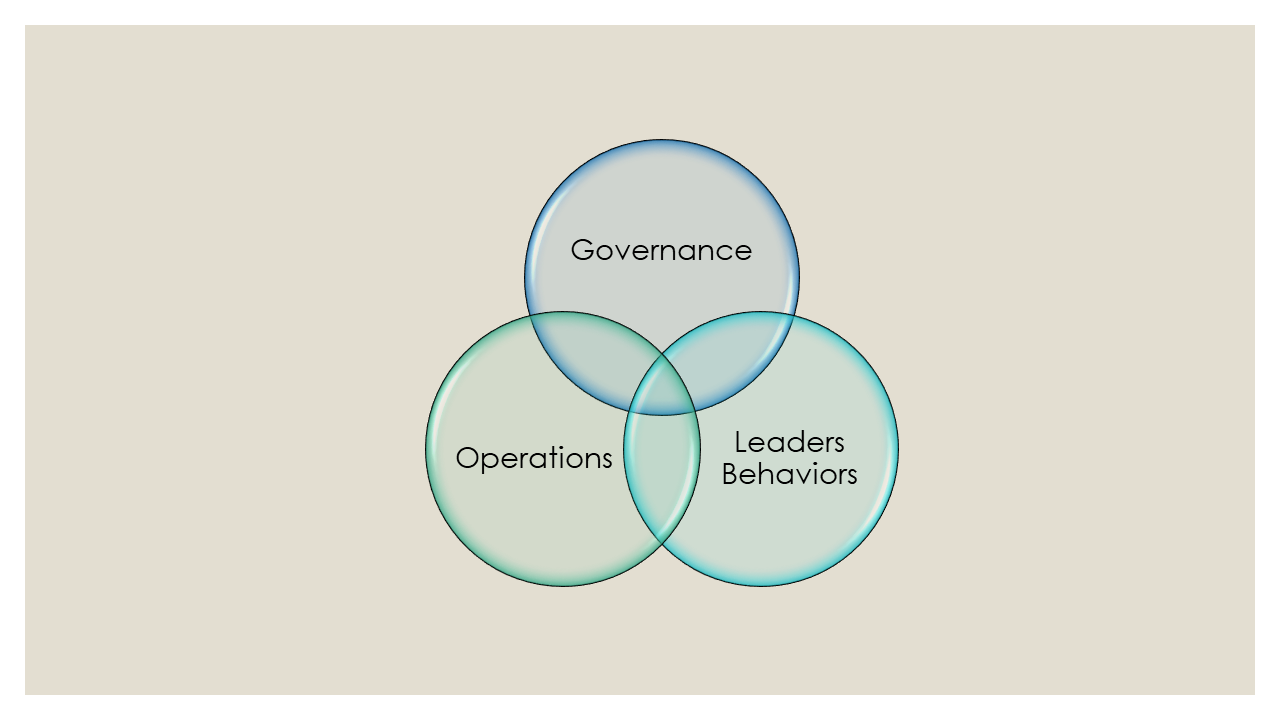
Leaders must be able to build the key steps in their collaborations that would enable them to create proper structures and systems for success. Archer and Cameron called this Three-legged tools, but in this particular case, we will call them Strategic collaborative tools and are shown in figure 3 below.
Figure 3: Strategic Collaborative tools
Based on figure 3 above, key areas of importance for each tool are: Governance involves creating proper engagement rules and contracting, which is key in any coalition, partnership, or collaboration. It can be a document that defines the focus and alignment of the shared vision and how success will look like. Governance also involves how the collaboration design looks like the organizational design, or coalition or partnership design and roles for each partner or individual in the collaboration. Operations involve the specific tools to be used in the collaboration in measuring success or milestones or progress; it could also imply the technology or the systems in place that would ensure proper execution of the collaboration, coalition, or partnership. Finally, Leaders’ behaviors are critical and this involves the skills and attributes that leaders should have, or learn to lead successful collaborations and these are also summarized in the below figures 4 and 5 below.
Engaging others means developing networking capabilities, relationship building, and communicating the shared vision and mission. Mediating involves the aspect of leaders addressing conflicts that arise in collaborations constructively and Influence skills means the aspect of leaders sharing control with responsibilities and also understanding the culture and personality of their partners and teams.
Figure 4: Skills of collaborative leaders
From the attributes perspective; Agility involves dealing with issues urgently and having a forward-looking attitude. Patience involves being authentic in your relationship and allowing time and space for your partner or stakeholder in addressing issues and also ensure there is proper alignment and an amicable schedule in deliverables. Finally, Empathy involves listening to others, allowing them to share their opinions, and understanding the angle they are coming from.
Figure 5: Attributes of collaborative leaders
So What Next?
If organization leaders, organizations, countries, political leaders want to see long-term success in their partnerships, coalitions, and partnerships, these are critical steps they need to employ in their personal, organizational, or political cultures. The need to understand the bigger picture, and why leaders are the central point of any successful coalition, collaboration, and partnership, and the need for leaders to develop proper structures from governance, operations, and their behaviors that means building requisite skills and attributes that will position them as collaborative leaders.
But, it doesn’t end there, this process is iterative and must be continually applied in the life of the coalition, partnership, or collaboration for purposes of sustainability. If not applied well then it would be a waste of time. Whether you are a corporate organization, a small business, a Nation or country, political parties or systems, and even religious organizations these steps of collaborations cut across every sector.
If the above makes sense to you and you wish to apply in your organization and doesn’t know how to let’s engage and see how we can develop a structured program for your teams especially leaders in understanding how to implement. If you like the article and feel it added value to you share your comments, feedback on the comments column of my email below.
Reference resources
Archer, D & Cameron, A. (2013). Collaborative leadership: building relationships, handling conflict and sharing control (2nd ed.). New York, NY: Routledge.
Bushe, G. R. (2010). Clear leadership: sustaining real collaboration and partnership at work. Boston, MA: Davies-Black.
Goleman, D. & Boyatzis, R. (2013). HBR’s 10 must-reads on collaboration. Boston, MA: Harvard Business Review Press
Gilbert Ang’ana is the Managing Director of Accent Leadership Group; an Authentic Leadership Coach, Speaker, and Teacher. A Researcher, Author, Life Strategist, and enthusiastic about collaborative, humane, and clear leadership. He is a Certified John Maxwell Team member; Certified ICF Engagement and Productivity Coach and a Ph.D. scholar in Organizational Leadership Development. He Coach, Speak, and Teach on matters of Leadership. Get in touch through info@stepafrique.com or view his profile on www.stepafrique.com or +254 762 990422.
The Quality of Your Thinking depends on the Models in Your Head.
Leadership Insights to Provoke your Paradigm Shift
In Life & Business if you have a few blind spots, you are unlikely to Win. There is an old adage that says, “ To a man with a hammer, everything looks like a nail”. This is not the same in real life; the more the tools you’ve at disposal the more likely you’ll get job done successful.
This book by Shane Parrish helps in understanding the additional tools at disposal to improve your decision making and problem solving which I have summarized as 2Ts & I
1. First Principles Thinking
There are always existing solutions to problems and many of us assume that these existing solutions that exists for a good reason will automatically solve our problems and so we apply them without questioning their assumption. This principle teaches us not to take existing solutions at the face value but, to interrogate and understand their rationale and come up with better enhanced solutions that will support your decision making; drill down and personalize your solutions.
Key steps here are: Examine existing solutions; Test its assumptions; Enlarge or personalize your solution
2. Second Order Thinking This challenges you to think beyond the outcome you are aiming at and consider the ripple effects of your decisions. This is critical and really helps you to avoid disastrous or unintended consequences as a result of your decisions.
Good example is if a leader at this period of COVID-19 makes a decision to recall all the staff back to work after a whole year working remotely with the aim of improving productivity, then the leaders decisions faces consequences such as; team virus exposure that may affect majority of team members who may fall sick and have more teams on sick off which eventually kills the productivity.
Key: before implementing any solution, simulate the second order thinking to understand the ripple effects of your decision.
3. Inversion This enables the leader to try and solve the opposite problem first in order to have clarity of the steps to undertake to the desired outcome. For example; If an organization wants to roll out a successful marketing campaign, they may simulate inversion to understand what would an unsuccessful campaign look like?
This would then help the teams to come up with steps to avoid an unsuccessful campaign that would enable them formulate proper steps for the desired outcome – which is a successful marketing campaign.
Key lesson: Invert your outcome; solve the opposite problem; which leads to your desired outcome.
SUMMARY:
The QUALITY of your OUTCOME depends on the MENTAL MODELS in your HEAD:
First Principle THINKING: Examine existing solution; Tests assumptions; understand underlying issues; Personalize your decisions.
Second Order THINKING: Simulate your ripple effects to your decision; Create a solution to mitigate the effect; Make the final call
Inversion Understand your outcome; Solve the opposite problem; Make a final call.
Book Review: By Gilbert Ang’ana – Founder & CEO Accent Leadership Group; Leadership Coach, Teacher, Speaker & Consultant!
Unleashing the New Competitive Edge – A Transformadaptive Leader!
Many Scholars, experts, technocrats, and innovators have over the last few years shared their insightful thoughts about technology, innovations as what will sustain organizations, businesses and even countries and give them a competitive edge. According to research data by The International Telecommunication Union (ITU), technology has become the new normal, it’s everywhere around us. ITU shared that over 50% of the world’s population uses the internet, over 4 billion daily searches in major search engines, we are just at the start of a revolution that is already touching every business, organization and life, over 90% of the world’s data has actually been created in the last few years only.
The future is for sure, uncertain and semi-predictable, many of the scientists and even technocrats and techno enthusiast don’t have 100% clarity, if there will be solutions for a number of issues facing humanity and organizations today; will we find the cure for cancer for example; how will the economy behave with COVID-19 now as part of us; will we be living in an algorithmic world, will majority of the workforce roles be replaced by machines, robotics? There is actually no 100% clarity of the future facts on these and many other aspects of technology and science. Critical though for individuals, businesses and organizations to understand is that there is for sure need to look at this aspects as opportunity presented. Many organizations and businesses have already embraced digital disruption and are reaping the potential that advances in new technologies, data analytics and artificial intelligence.
The pressure to keep up with the innovations amid technological progress however need not to make us obsessed, and keep thinking that innovations and technological advancement alone will drive our organizations, businesses and countries competitive edge now and in the future – NO! Whereas these advancements poses an opportunity for individuals, businesses and organizations to rethink the work they do and the way they do it, this will not entirely provide the competitive edge anymore; this is the new normal as we progress, you cannot survive as an organization, a business, without the basic foundational aspects of technological advancements, this is not and will not be a competitive edge.
The question that I pose to you as an individual, business or organization is – Are you ready for the new competitive edge that will enable your organization have a sustainable future growth beyond technological advancement?
Our research shows that the ability to transform & adapt is one of the single most important competitive edge that will separate progressive sustainable organizations from average ones. While there are plenty of admirable and great organizations out there, there are only a handful of organizations that have shown so far the last couple of years and even couple of months in 2020 that they are able to pervade vigor, rigor, connection and intensity into their daily actions, behaviors and culture for them to have sustainable greatness in the future.
Step-Afrique Transformadaptive Leadership Loop
This therefore, gives rise to the new competitive edge, which is – The Re-Invention of Leadership – The Transformadaptive leaders in organizations. These are leaders who are both Transformational, which means according to businessdictionary.com that these leaders identify the needed change, creates a vision to guide the change through inspiration, and executes the change with the commitment of the members of the group; and Adaptive, which means according to Cambridgeleadership.com these leaders help individuals and organizations adapt and thrive in challenging environments, they are able, both individually and collectively, to take on the gradual but meaningful process of change, diagnose the essential from the expendable and bring about a real challenge to the status quo.
From our research where we engaged with a number of key leaders in Kenya, we found that, more that 75% of respondents shared they agree or strongly agree that many leaders are not transformadaptive or are not executing their organization vision with full commitment from them; many leaders are not fully able to diagnose the expendable and bring about real challenge of the status quo in their organizations; and more profound is that many leaders are not fostering engagements and not modeling the progressive champions mindset of their organizations.
75% of respondents said they agree or strongly agree that many leaders are not transformadaptive
It’s important to realize that transformadaptive leadership in the new competitive edge 2021 and beyond for many organizations and businesses that will support them integrate the uncertain future of technological advancements and innovations with the human innovations and provide sustainable environment for their teams, within the organizations to perform at optimal levels that will ensure their organizations survival beyond the chaos, disruption and environmental changes both economical, physical, and human as we progress.
Transformadaptive Leadership in the new competitive edge 2021 and beyond
Gilbert Angana
To understand what makes a leader transformadaptive, Accent Leadership Group (Step-Afrique) from its launched research, found out that leaders self-drive, or vision or interrelationships alone are not enough; the leaders, who have clarity of vision, are self-drive and relate well with colleagues and teams may find that they are driving performance yes, they are hitting the targets yes, they relate well with teams and colleagues for purposes of driving performance only but their performance may not be sustainable for the long term, their team relationship may not be sustainable for the long term, and may be the leaders who come in bring results short term then leave the organization is a much worse state as a result of the short term damage they have done and they move to other organizations to do the same.
Instead Transformadaptive leaders are those who use their unique combination of strengths like being self-aware, self-led, and have clarity of their esteem to drive strategic thoughts in their teams, instigate strategic actions and create strategic influence in their organizations and business; they then move to a higher scale of driving inspirational connections with their teams, mindful of their environment and nurture the culture of self-care in their teams to avoid stress and burnout in their teams and are have clarity of their ability and efficacy; this is their pinnacle of consciousness as leaders and this is what makes leaders transformadaptive.
Dr. John C. Maxwell said that: “leaders get the culture they create, and the nature of the culture affects what they can or cannot do in their organization”. And am emphasizing from an organization point of view that organizations get the leaders they create, and the level of their leaders affects what they can achieve now and into the future and what they will fail to achieve. Their organization level is determined by the level of their leaders.
“leaders get the culture they create, and the nature of the culture affects what they can or cannot do in their organization”
Dr.John C. Maxwell
How can organizations ensure they have the leaders that will definitely drive and champion their sustainable future based on all the uncertainty and unpredictability of our environment?
The answer is short, they need to Build a Transformadaptive Leadership Culture in their organizations.
This will only be possible when the organization systematically SHARPEN their leaders IN – their leaders’ capability to Self-Leadership; BUILD their leaders – OUT, their capability to drive Strategic Leadership; finally DEVELOP their leaders UP – their aspects to be Conscious Leaders. This is how organizations can kick off, creating Transformadaptive Leadership Culture in their organization that will give them a competitive edge.
Step-afrique desire is to take you through the entire process of creating a transformadaptive leadership culture in your organization step-by-step. If you desire to improve your organization, your leaders, your team and be sustainable and have competitive edge moving forward, you will definitely need to learn each of the steps that enable your leadership be transformadaptive.
I help leaders sharpen their Self-Leadership, build their Strategic Leadership, and develop their Conscious Leadership, so that they can be transformadaptive.
For the better part of this year, I have been studying some patterns of leadership, looking at the traits, behavior, and actions of various leaders both locally and globally, and what really makes such leaders transformational besides the usual theoretical frameworks of being charismatic, being emotionally intelligent or serve others.
I have heard various discussions and interviews with a number of leaders here in Kenya from spiritual leaders, to business leaders, to corporate leaders, leaders in government public institutions, leaders in private institutions, leaders in non-government or not for profit institutions among many others just to try and understand the common patterns among these leaders and what is the recipe for the inspiration they share with the teams that lead to transformation in tasks and organizations they lead.
I went further to review their application of the common leadership values below that based on various empirical studies are key traits that transformational leaders portray and I summarized only key traits that cut across them as below:
Vision; here I reviewed their abilities to understand their goals and develop clarity on the action plan with the team to achieve them. 97% of them feel this is a critical value they developed earlier in their leadership and continually nature.
Passion; In our discussion, I gauged their personal level of fulfillment and motivation that drives them even in the midst of challenges and setbacks and how this is transferred to their teams. All leaders engaged agree that without passion they would not have achieved what they have.
Elasticity; we review their level of mental stretch or resilience amidst adversity; and how fast they recover or recovered despite the obstacles. 82% of the leaders position this as critical but, others felt it a difficult value or skill and they are not sure if they have grasped it yet.
Influence; where I reviewed their ability to encourage, motivate, and guide their teams to think or act differently to achieve certain goals. Without influence, there is no leadership and therefore you are not inspirational. All leaders were aligned leadership is influence.
Devotedness; here we discussed their commitment to follow through with their teams on specific tasks they are keen on without fail or dropping; their daily schedules based on impact. All leaders were aligned on the aspect of setting daily action plans that are both non-negotiable and negotiable to avoid being swayed by the daily wild winds of activities.
Pliancy; we discussed and reviewed their level of preparedness of the mind and character to accept and respond to change. For a leader to transform and inspire their teams this level of mental and character strengthen is key, which was unanimously agreed by all discussed leaders.
Probity; their perspective on honesty, genuineness and focus on doing things right or the right thing. 80% of the leaders agreed probity is what they aspire to be and most were, however, some unwarranted business ethical issues and dilemmas sometimes crop in, but they strive to ensure they make the best or closest ethical decisions.
Compassion; their ability to connect with the feelings and emotions of their teams and understand their actions and behaviors.
Advancement; their strong-willed, non-negotiable focus on their continual learning, and personal growth.
The above values and skills if I could call them so, were common and at a higher scale for all the leaders, I interacted with and discussed on matters leadership and what has supported them over the years as inspirational and transformational leaders in their spaces.
Based on the above, at Step-Afrique we went ahead and do some further analysis and summarized the above into three main focus leadership areas that all such transformational leaders have developed over the years and are still developing at the specific level that continues to support them to inspire, and transform the various leadership spaces they are in and we called this Step-Afrique Leadership Loop (SALL). This loop as can be seen below focuses on three areas of any leader and if well-developed will be the recipe for inspiration and transformation in them, their teams, and in the organizations they operate from.
Step-Afrique Leadership Loop (SALL) has been originally developed by Gilbert Angana (PhD Scholar) and CEO of step-Afrique based on engagements, with various local leaders considered inspirational in their spaces and study of with various leaders across the global on patterns, traits and actions.
If an organization can focus on developing these three critical focus leadership areas, then they are likely to have optimal productivity from their leaders, and consequently, their teams will have a long term transformation in their organizations; The Step-Afrique Leadership Loop covers the: IN (Mind of the leader); OUT (Will of the leader): and UP (Heart of the leader). to break t down further;
The IN – MIND covers the aspects that develop the leaders Self-Leadership capabilities and specifically from our research and findings develops three critical areas of developing the leaders: Self-Esteem; Self-Awareness & Self-Management.
The OUT – WILL covers the aspects that develop the leaders’ Strategic-Leadership capabilities and touches on developing leaders on their Thinking, Action, & Influence to enable them to be strategic. You cannot develop your OUT as a leader without developing your IN.
The UP – HEART is the result of the above two and the most critical aspect of a transformational leader, but it cannot be developed in isolation without developing the IN and the OUT. This is the expression of the leaders’ Self-Efficacy, Relational Awareness/Connection, and Environmental Mindedness. This is the apex of Conscious Leadership and leaders at this level are truly inspiring and transformational in every aspect of their lives.
In conclusion, it is important to understand that these aspects are also intertwined in as much as they are anyone sequential and anyone can develop their capabilities and be inspirational and eventually transformational, but it is a conscious journey that they have to take to continually develop their IN, their OUT, and nature their UP and in that loop. Even as transformational leaders today, they still are in this vicious circle of frequently developing their IN-OUT-UP at their level for them to maintain their focus, and inspiration across their lifetime.
This is what we specifically at Ste-Afrique, to help individuals and organizations develop their leaders through the Step-Afrique Leadership Loop (SALL) with customized, globally tested leadership programs that are also John Maxwell Certified Programs. We walk with you on a journey to continuously help you develop your IN (Mind) so as you improve on your Self-Leadership; Develop your OUT (Will) so as you develop your Strategic Leadership: and finally nature your UP (Heart) to start applying your Conscious Leadership in all aspects of your life.
Article and Research by Gilbert Ang’ana CEO Step-Afrique who is also a PhD Scholar in the area of Organizational Leadership Development. For details of this contact him at angana@stepafrique.com
Engage us for details on how we can work with you on this journey.
Step-Afrique Consultancy trading as Accent Leadership Group; contact details below:
Covid has come with its effects, both positive and negative and the majority of the sectors have had a negative effect and I continue joining each of us in prayers and pushing particular policy agendas that will see some cushion or at least some improvement in the heavily affected areas. However, Covid has also come with positives, which are a shift, a spark, a new focus for each of us and even organizations to move from their status quo to new territories, new grounds, and new beliefs without forgetting our foundational bearing in Christ.
Download the attachment at the bottom for detailed read on this article and share your comments and feedback.
How do you know you are Consuming?
You just want to be served, the church to care for you, the church to call you, the church to tell you what to do next – Why can’t you start producing, add value, contribute positively to the plans, call the church share your views – SERVE.
You feel entitled, that the church should be doing things for you for it to be a church – start having a GRATEFUL HEART – The church did something for you, why not start doing something too.
You keep asking your church what they are doing – why not change that to – what do you need? – What Can I do?
You have an issue with your cell group, missional group, or whatever your church calls, you don’t feel that is church enough to fill your spiritual cup – Why not join that group and champion for the things that you need to fill your spiritual cup so that every one spiritual cup can be filled too at that level?
What are you Producing this season? Or rather what have you been Producing?
A Producer Christian is focused on advancing the mission of Jesus – the Great Commission.
A Producer Christian understands the truth – it is more blessed to give than to receive.
A Producer Christian does not expect everything to go their way.
A Producer Christian is open to sacrificing for an opportunity for someone else to come to know Jesus.
Jesus says in Matthew 20:28, that he “did not come expecting to be served by everyone, but to serve everyone…”